The 2026 Boston Marathon Course
MarathonGuide Staff
Apr 06, 2026
COPY LINK
On Patriots’ Day, Monday, April 20, 2026, over 30,000 competitors from nearly 130 countries will gather for the 130th Boston Marathon presented by Bank of America — a race that has defined endurance running for well over a century.
A Living Piece of History
Established on April 19, 1897, just one year after the revival of the marathon at the 1896 Athens Games, the Boston Marathon is the oldest annual marathon competition in the world and a proud member of the Abbott World Marathon Majors. Running it is not simply a physical test — it’s a passage through American sporting legend.
The Course at a Glance
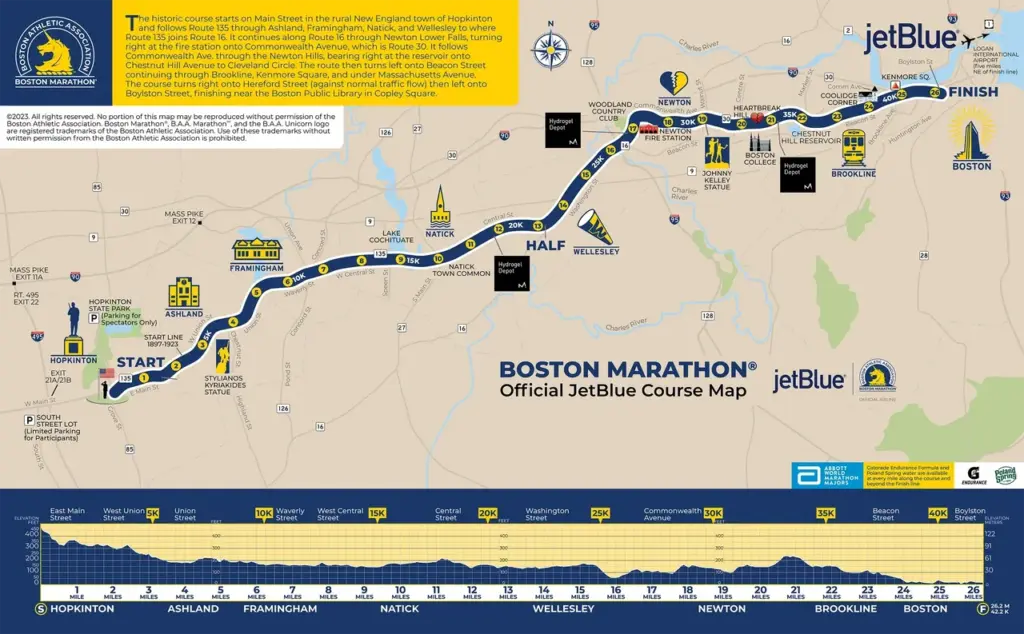
The course consists of paved city streets, beginning in the rural township of Hopkinton and proceeding through several cities and towns, including Ashland, Framingham, Natick, Wellesley, Newton, and Brookline, before finishing in Boston. Notable features include the challenging Newton Hills and the famous Heartbreak Hill.
The course features a net downhill overall, starting at 475 feet above sea level and finishing at about 16 feet. However, there are several rolling hills, including the four Newton Hills, with Heartbreak Hill peaking at approximately 20 miles into the course.
Don’t let that net downhill fool you. The route drops 1,239 feet overall and gains only 829 feet, but the specific placement of these elevation changes creates the race’s central strategic puzzle.
The Start: Hopkinton (Miles 0–1)
The historic course starts on Main Street in the rural New England town of Hopkinton and follows Route 135. What greets runners immediately is deceptively dangerous: the steepest downhill section of the entire course, at -5.3% grade, occurs in the very first half-mile, dropping 142 feet. Running this section too aggressively is a classic Boston mistake — the eccentric loading on the quadriceps here can come back to haunt runners on the Newton Hills miles later.
Early Miles: Ashland, Framingham & Natick (Miles 1–10)
The route begins on East Main Street before turning into West Union Street in Ashland, then following Union Street until branching off onto Waverly Street into Framingham. These early miles through sleepy suburban towns are relatively flat and forgiving — a chance to settle into rhythm and conserve energy for what lies ahead.
The Halfway Mark: Wellesley and the Scream Tunnel (Miles 10–13)
Arguably the most electrifying single stretch of any marathon in the world arrives around Mile 12. Wellesley College, located near Mile 13, cancels classes for the day, and students line up to create what they call the Scream Tunnel — a wall of sound, unbroken for the duration of the race and amplified by loud music, colorful signs, high fives, hugs, and kisses to cheer on the runners.
Less than 200 yards into Mile 13 is the race’s halfway mark. Runners turn left onto Route 16 and head through blocks lined with shops as the course leads them east from Wellesley Center.
The Newton Hills: Where Races Are Won and Lost (Miles 16–21)
After crossing into Newton, the course begins its most demanding stretch. Almost immediately, runners pass the “Entering Newton” sign and start a long half-mile uphill climb along the Route 128 overpass. The elevation of the overpass amplifies any weather elements in play — wind, rain, or heat.
After going through a mostly flat residential area, runners turn right at the firehouse onto Commonwealth Avenue. Just after Mile 19, runners cross Walnut Street, where the “Forever Young” statue of John A. Kelley shows Boston’s famous marathon runner as a young athlete next to his older self.
Then comes the beast.
Heartbreak Hill (Mile 20–21)
Heartbreak Hill is the notorious Newton hill at Mile 20. It is the fourth and final of the Newton Hills, and it arrives precisely when runners’ legs are most depleted. The name itself comes from the 1936 race, when Ellison “Tarzan” Brown surged past Johnny Kelley just before the crest, breaking Kelley’s heart and spirit. More than eight decades later, it still lives up to its name.
The Final Push: Brookline to Boylston Street (Miles 21–26.2)
Cresting Heartbreak Hill does not mean the race is run. The descent from Mile 21 to 21.4, at a -4.54% grade, can cause legs to buckle if eccentric muscle damage from the earlier downhill sections was too severe.
Runners follow Beacon Street through Brookline before turning back onto Commonwealth Avenue in Boston. From there, the course turns right on Hereford Street before making its final turn onto Boylston Street for three blocks to the finish line.
One last psychological test awaits. The iconic Citgo Sign at Mile 25.2 dominates the horizon long before runners actually reach it, testing mental patience. The turn onto Hereford Street at Mile 25.8 features a minor incline of approximately 1.9% that feels significantly harder due to exhaustion.
Then, finally: Boylston Street. The roar of the crowd. The finish line.
Race Day Logistics
Start times are staggered across waves: Men’s Wheelchair at 9:06 a.m., Women’s Wheelchair at 9:09 a.m., Handcycle & Duo Participants at 9:30 a.m., Professional Men at 9:37 a.m., and Professional Women at 9:47 a.m.
Weather on Patriots’ Day traditionally varies considerably, with starting temperatures in the low 40s typically rising to the low 60s by midday. The course is notably exposed to wind — a tailwind from the west can produce record-breaking performances, while an easterly wind off the harbor can transform the final miles into a grueling battle.
The Records to Chase
Kenya’s Geoffrey Mutai set the men’s course record in 2011 with a time of 2:03:02, while Kenya’s Sharon Lokedi set the women’s record in 2025 with a time of 2:17:22.
From the rolling hills of Hopkinton to the thunderous finish on Boylston Street, the Boston Marathon course is a masterpiece of drama, history, and suffering in the best possible sense. Whether you’re lining up to race it, cheering from the sidelines, or watching from afar, the 130th running promises to be as unforgettable as every edition before it.
COPY LINK
You are free to use this material for non-commercial purposes. This means you can read it, share it with others, and use it in your own personal projects. For more information on the rules for using this material, please read the following documents:
Creative Commons LicenseAll rights reserved. Copyright © 2026 Marathon Guide